

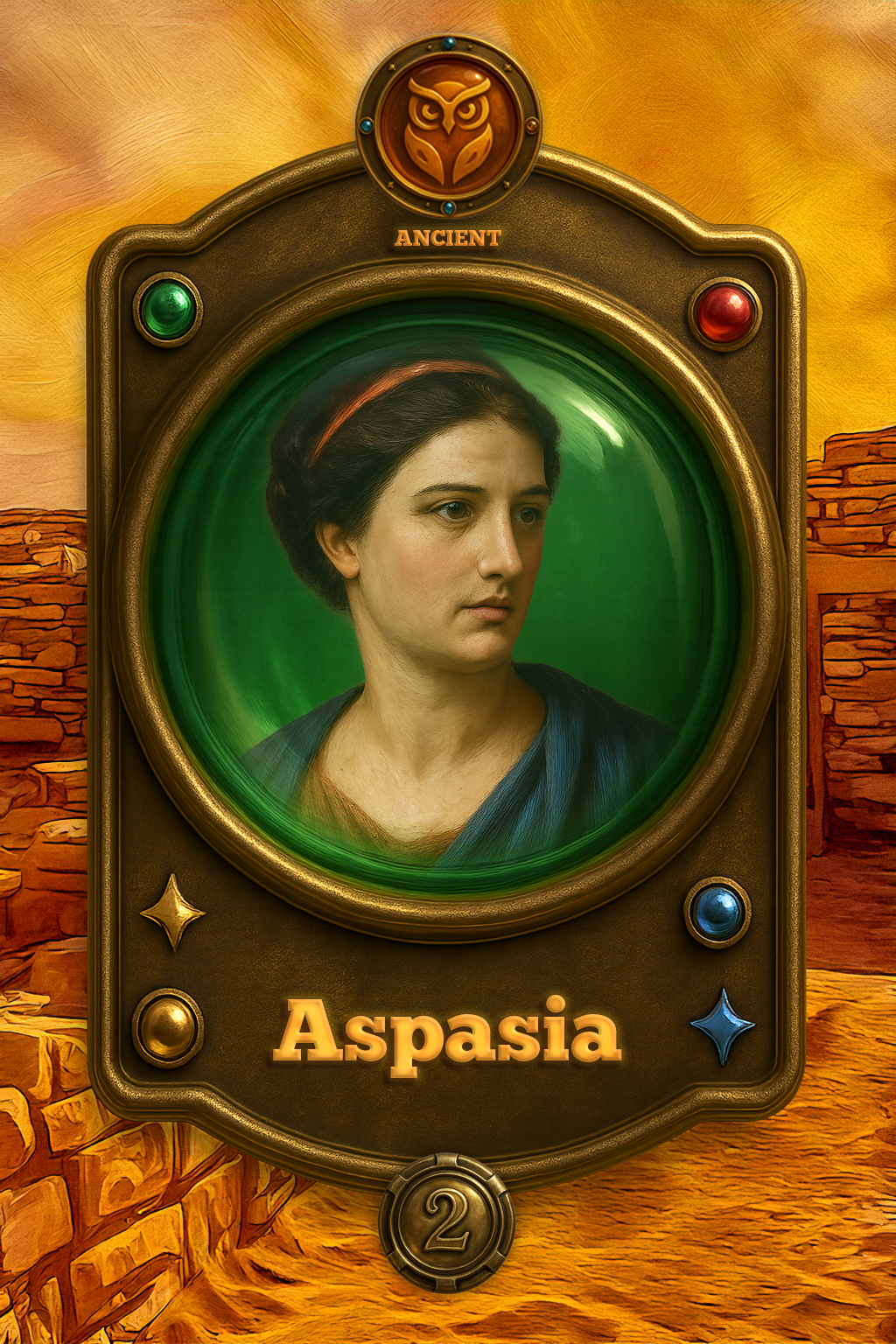
Description
She was born far from the heart of Athens, yet came to shape its voice. Aspasia of Miletus, companion of Pericles and teacher of orators, lived in a city where women were seldom seen in the public square — yet her name endures in the memory of philosophy, rhetoric, and politics.
Aspasia was no passive figure in the Periclean age. Trained in the arts of speech and argument, she hosted gatherings where philosophers, statesmen, and thinkers exchanged ideas. In a society that veiled women from the civic sphere, she became a rare and luminous exception — not because she broke rules, but because she transcended them.
Plato, in the _Menexenus_, places a funeral oration in the mouth of Socrates — who claims, with ironic admiration, to have learned it from Aspasia herself. Whether in jest or in earnest, the implication is clear: she was a teacher even to the greatest questioner of Athens. Xenophon too preserves her as a model of clarity and insight in matters of love and virtue.
The comic poets ridiculed her — as they did anyone who disturbed Athenian norms. But beneath their satire lies a deeper truth: Aspasia unsettled the world not with scandal, but with intelligence. Her presence in the intellectual life of Athens was not ornamental, but structural.
She helped shape the rhetoric that would define democratic Athens. She stood beside Pericles not as ornament, but as interlocutor. She influenced Socrates not with doctrine, but with dialectic. In a culture that rarely recorded the thoughts of women, her voice echoes — not through books of her own, but through the words of those she shaped.
Aspasia did not ascend the Pnyx or write dialogues. But the fact that her intellect was remembered — in a city allergic to female autonomy — is itself a monument. She is a reminder that philosophy is not only a lineage of texts, but a lineage of minds in conversation. And Aspasia, against all odds, entered that conversation — and changed it.
